 Fenwickgoods
Understand how moment arms alter tension throughout a full range of motion. You will learn to pick exercises that maintain continuous tension on target fibers.
The relationship between the force a muscle can produce across a joint range of motion and the external load applied to that joint dictates the stimulus of any given repetition. Many lifters assume that moving a barbell or dumbbell through space applies a uniform challenge to the working tissue from the start of the eccentric to the finish of the concentric phase. In reality, basic skeletal anatomy and classical mechanics dictate that the resistance felt by the muscle fluctuates continuously throughout every degree of joint travel.
When an external resistance profile clashes with a muscle's underlying force capability, the exercise hits an artificial sticking point. The movement is halted not because the target muscle as a whole is fatigued, but because leverage was unfavorable at a single joint angle. Aligning the resistance profile of the implement with the biological strength curve of the muscle distributes mechanical tension more evenly across the active range of motion, reduces joint shear at mechanically vulnerable angles, and improves training stimulus per unit of fatigue.
Internal versus External Moment Arms
Musculoskeletal movement requires balancing two opposing systems of rotational force: internal torque and external torque. Torque is the product of a force multiplied by the perpendicular distance from its line of action to the axis of rotation. That perpendicular distance is termed the moment arm. For joint rotation to happen, the internal torque generated by the muscle must exceed the external torque generated by the load.
The internal moment arm represents the perpendicular distance between the tendon's line of pull and the center of the joint axis. This distance changes throughout the movement. For example, during elbow flexion, the internal moment arm of the biceps brachii measures roughly 3.0 to 3.5 centimeters when the arm is fully extended. As the elbow flexes toward 90 degrees, this distance expands to roughly 4.5 to 5.0 centimeters before shrinking again as the forearm approaches the upper arm. A longer internal moment arm provides a mechanical advantage, meaning the muscle requires less contractile force to create joint torque at that specific angle.
The external moment arm is the perpendicular distance between the line of force of the external load (such as the line of gravity acting through a barbell) and the joint's axis of rotation. In a standing barbell bicep curl, the external moment arm is nearly zero at the bottom, reaches its peak when the forearm is parallel to the floor at 90 degrees of flexion, and drops back toward zero as the bar moves toward the shoulder. If an individual holds a 20-kilogram bar at 90 degrees of elbow flexion with an external moment arm of 30 centimeters, the external torque is 58.8 Newton-meters. The biceps must generate enough tension across its internal moment arm to counteract and exceed that rotational force.
| Joint Angle (Elbow Flexion) | Estimated Internal Moment Arm | External Moment Arm (Free Weight Curl) | Mechanical Demand on Biceps |
|---|---|---|---|
| 0 degrees (Fully extended) | Small (~3.2 cm) | Minimal (~2.0 cm) | Low external torque |
| 90 degrees (Mid-range) | Maximum (~4.8 cm) | Maximum (~30.0 cm) | Peak external torque |
| 135 degrees (Fully flexed) | Moderate (~3.8 cm) | Small (~8.0 cm) | Low external torque |
The Ascending and Descending Strength Curve
A strength curve illustrates how much force a muscle-joint complex can produce at different points in its range of motion. These curves fall into three primary classifications: ascending, descending, and bell-shaped. The shape of the curve is governed by two factors: the internal moment arm variations discussed above, and the physiological length-tension relationship of the sarcomeres.
Sarcomeres contain overlapping thick (myosin) and thin (actin) myofilaments. Optimal force generation occurs at resting lengths where the maximum number of cross-bridges can form, typically between 2.0 and 2.2 micrometers of sarcomere length. When a muscle is stretched past this zone, fewer cross-bridge attachments can form, reducing active contractile force. When the muscle shortens excessively, actin filaments overlap and interfere with each other, while the thick filaments compress against the Z-discs, causing active force production to decline. The overall strength curve is the sum of these microscopic sarcomere properties and the macroscopic joint leverage.
- Ascending strength curve: Force production capacity increases as the joint extends or reaches the end of the concentric movement. The back squat and barbell bench press are textbook examples. An individual can support significantly more load near lockout than out of the deep hole of a squat, due to advantageous skeletal alignment and closing external moment arms at the hip and knee.
- Descending strength curve: Force production capacity decreases as the muscle contracts and the joint closes. Rows and leg curls exhibit descending characteristics. A trainee is considerably stronger when the hamstring is elongated at 0 to 15 degrees of knee flexion than when the knee approaches 90 to 105 degrees of flexion, where active insufficiency limits hamstring force output.
- Bell-shaped strength curve: Force production capacity peaks in the mid-range of movement and falls off at both extreme stretch and deep contraction. Deltoid abduction and elbow flexion display bell-shaped curves, tracking the rise and fall of both muscle leverage and favorable sarcomere overlap.
Why Free Weights Lose Tension at Peak Contraction
Gravity acts in a single direction: downward, along a vertical vector toward the center of the earth. Because of this, the external moment arm of any free weight is calculated by measuring horizontally from the vertical line of action of the weight to the joint center. When the limb or lever arm moves toward a vertical orientation, that horizontal distance shrinks rapidly, dropping the external torque toward zero regardless of the weight on the bar.
Consider the dumbbell lateral raise. At the bottom of the movement, when the dumbbells hang at the sides of the hips, the external moment arm to the glenohumeral joint is virtually non-existent. The deltoid experiences minimal rotational challenge in this lengthened state. At 90 degrees of humeral abduction, the arm is perpendicular to the pull of gravity, producing the longest possible external moment arm. As a result, the deltoid faces peak mechanical demand at the precise moment it enters its shortest, mechanically weakest state. If the dumbbell is brought even slightly higher, the moment arm begins to shorten again.
A similar issue occurs in a standard dumbbell chest flye performed on a flat bench. At the bottom of the repetition, the pecs are stretched, and the horizontal distance from the shoulder to the dumbbell is roughly 35 to 45 centimeters, placing high torque on the chest. As the hands sweep upward and meet directly over the sternum, the dumbbell sits vertically above the shoulder joint. At this point of peak pectoral shortening, the external moment arm drops to zero. The muscle produces negligible tension to keep the weight there, denying the lifter any meaningful overload in the fully shortened range.
Using Bands and Cables to Reshape Profiles
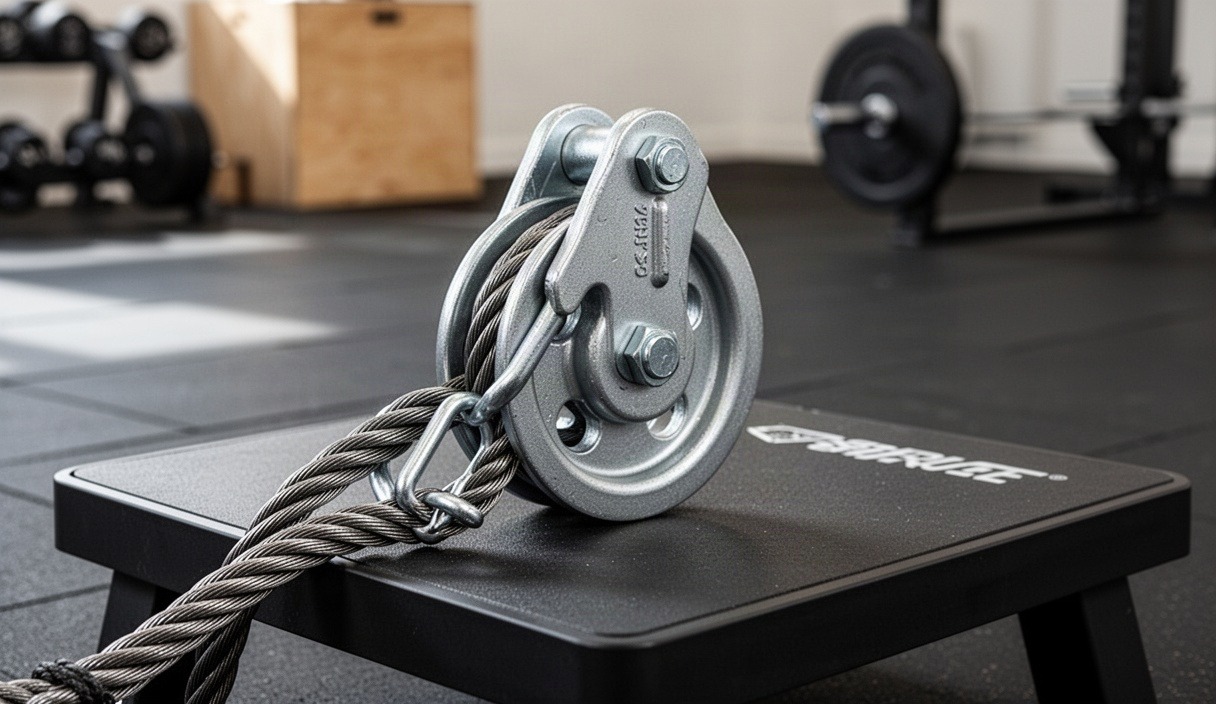
Cables and resistance bands decouple the line of force from the vertical pull of gravity, allowing lifters to reshape where an exercise feels hardest. A cable's line of force runs directly along the path of the cable toward the first redirecting pulley. By adjusting the height and position of that pulley relative to the body, a lifter can shift the point of maximal torque to any point along the range of motion.
To match an exercise to a muscle that is strongest in its shortened range, the cable should be arranged to form a 90-degree angle with the working limb at full contraction. Conversely, if high tension in the lengthened position is required, the cable should be set up so the 90-degree angle occurs when the joint is in deep stretch, falling into a flatter, sharper angle as the joint closes. For a horizontal chest flye, setting the cables slightly wider and setting the pulley height at mid-chest keeps the line of pull perpendicular to the arm even at the completion of the repetition, preserving tension where free weights lose it completely.
Elastic bands introduce dynamic variable resistance governed by Hooke's law: force equals the spring constant multiplied by the displacement distance. As the band stretches, its force output increases linearly. Adding bands to an exercise with an ascending strength curve, such as a back squat, produces a closer match between capacity and resistance. As the lifter ascends and joint leverage improves, the band stretches and increases load by 12 to 24 kilograms per side, maintaining a high level of motor unit recruitment all the way to completion without overloading the fragile bottom position.
Evaluating Machine Lever Systems
Modern plate-loaded and selectorized machines alter external moment arms using mechanical cams and multi-bar linkages. A cam is an eccentric pulley with a variable radius. As the machine's cable or belt travels over the rotating cam, the distance between the cable and the cam's axle varies, which continuously changes the mechanical advantage provided to the user.
To evaluate whether a machine fits an intended target, inspect the shape and orientation of the cam. When the cam radius is small, the machine's resistance torque decreases, making the exercise feel lighter at that point. When the cam radius widens, the resistance torque increases, loading the user more heavily. A properly engineered hamstring curl machine features a cam that starts wide at full knee extension and narrows toward full flexion, mirroring the descending strength curve of the hamstrings as they enter active insufficiency.
| System Type | Resistance Mechanism | Peak Tension Zone | Best Application |
|---|---|---|---|
| Circular Pulley Machine | Constant radius wheel | Where limb segment is perpendicular to cable | Uniform external moment loads |
| Eccentric Cam Machine | Variable radius pulley | Where cam radius reaches its maximum distance | Matching complex strength curves |
| Direct Free Weight | Vertical gravity vector | Where limb segment is perpendicular to gravity | Overloading mid-range positions |
| Free Weight with Bands | Gravity plus linear elastic tension | Near the top / lockout of the movement | Ascending strength curve exercises |
In lever-based plate-loaded machines, the pivot point of the weight carriage relative to the pivot point of the user's limb dictates the load profile. If the weight horn moves through a horizontal plane, the external torque peaks when the lever arm is parallel to the ground. If the machine's pivot point does not align with the anatomical axis of the joint, shear forces will travel into the connective tissues, and the resistance profile will drift away from the muscle's natural mechanics.
Checklist for Exercise Selection
Before selecting or programming a movement to target a specific muscle group, evaluate the mechanical environment by running through this practical sequence:
- Identify the target muscle's physiological curve: Determine whether the target muscle is naturally strongest in its lengthened, mid, or shortened position based on its sarcomere operating ranges and internal moment arm paths.
- Trace the line of force: For free weights, drop a straight vertical line downward from the center of mass. For cables, follow the line running directly from the pulley to the point of attachment. For bands, trace the vector from the anchor point to the limb.
- Locate the primary joint axis of rotation: Pinpoint the anatomical hinge point (for example, the lateral epicondyle of the femur during knee extension movements).
- Measure the external moment arm across the sweep: Identify where the perpendicular distance between the line of force and the joint axis hits its absolute maximum, and where it falls toward its minimum.
- Compare the two curves: Check if peak external torque coincides with the range where the muscle has adequate internal leverage and sarcomere overlap. If peak external torque occurs where the muscle is at its weakest, determine whether an alternative implement (cable, cam, or band) should be substituted.
- Verify anatomical alignment: If using a machine, confirm that the mechanical axle of the machine aligns with the joint axis through the full range of motion. If they drift out of line by more than 2 to 3 centimeters, adjust the seat height or pad placement.
Common Mistakes
One frequent mistake is overloading an exercise heavily in the lengthened position without adequate joint preparation or progressive volume management. Exercises like the incline dumbbell flye or deep Bulgarian split squat place peak external torque on muscle fibers at long sarcomere lengths. While this can provide a potent stimulus for hypertrophy, it also introduces substantial microtrauma and passive structural strain. Lifters with past tendinopathies or joint restrictions should consult a physical therapist or sports medicine specialist before loading heavily in extreme lengthened ranges.
Another error is blindly anchoring elastic bands to descending strength curve movements. Anchoring bands to a barbell bent-over row increases resistance exponentially as the bar reaches the abdomen. Because the latissimus dorsi and rear deltoids face poor leverage and active insufficiency in this deeply retracted position, the bands force the lifter to rely on momentum, hip extension, or spinal hyperextension to finish the repetition, removing tension from the targeted back musculature.
Finally, lifters often misjudge bench and body angles. Adjusting an incline bench from 45 degrees to 30 degrees alters the external moment arm acting on the anterior deltoid and clavicular head of the pectoralis major by several centimeters. Failing to understand how minor shifts in torso angle change the external moment arm causes lifters to unintentionally switch primary movers mid-set.
Practical Next Steps for Programming
To implement these biomechanical principles into a current routine, begin by auditing primary exercises across each major movement pattern. Note down the location of the hardest portion of each lift. If an entire training session relies exclusively on exercises that are hardest in the mid-range (such as standard barbell presses, squats, and basic curls), the muscles are missing exposure to varied force profiles.
Pair movements with complementary profiles across a training week. For shoulder abduction, balance a standard dumbbell lateral raise (which peaks at 90 degrees of abduction) with a low-to-high cable lateral raise where the cable crosses the body at roughly 30 to 45 degrees, which loads the initial third of the movement. For the hamstrings, combine a Romanian deadlift, which challenges the tissue in the lengthened position, with a seated leg curl using a cam-driven machine that sustains load into deep flexion.
When training on selectorized machines, spend several minutes experimenting with seat adjustments. Raising or lowering a seat by a single notch can align an anatomical joint axis with a machine pivot, eliminating unwanted joint shear. Record training loads based on the specific resistance profile used, as a 40-kilogram cable row set to challenge the shortened position will not match the load of a 40-kilogram row loaded with free weights.
This content serves educational purposes only; consult a qualified physician or physical therapist before altering your training load. Disclaimer